CRC-MedAI
Real-time clinical decision support for colorectal cancer, with computer vision wired into a hospital workflow.
- Year
- 2026
- Role
- Sole engineer & researcher (M.Sc. thesis)
- Status
- Research · IEEE CBMS 2026 target
The problem
Colorectal cancer screening generates more imaging than clinicians can read quickly, and most research models never leave a notebook. The gap is not the model. It is everything around it: getting a prediction to a clinician, inside their workflow, fast enough to use live and explainable enough to trust.
The approach
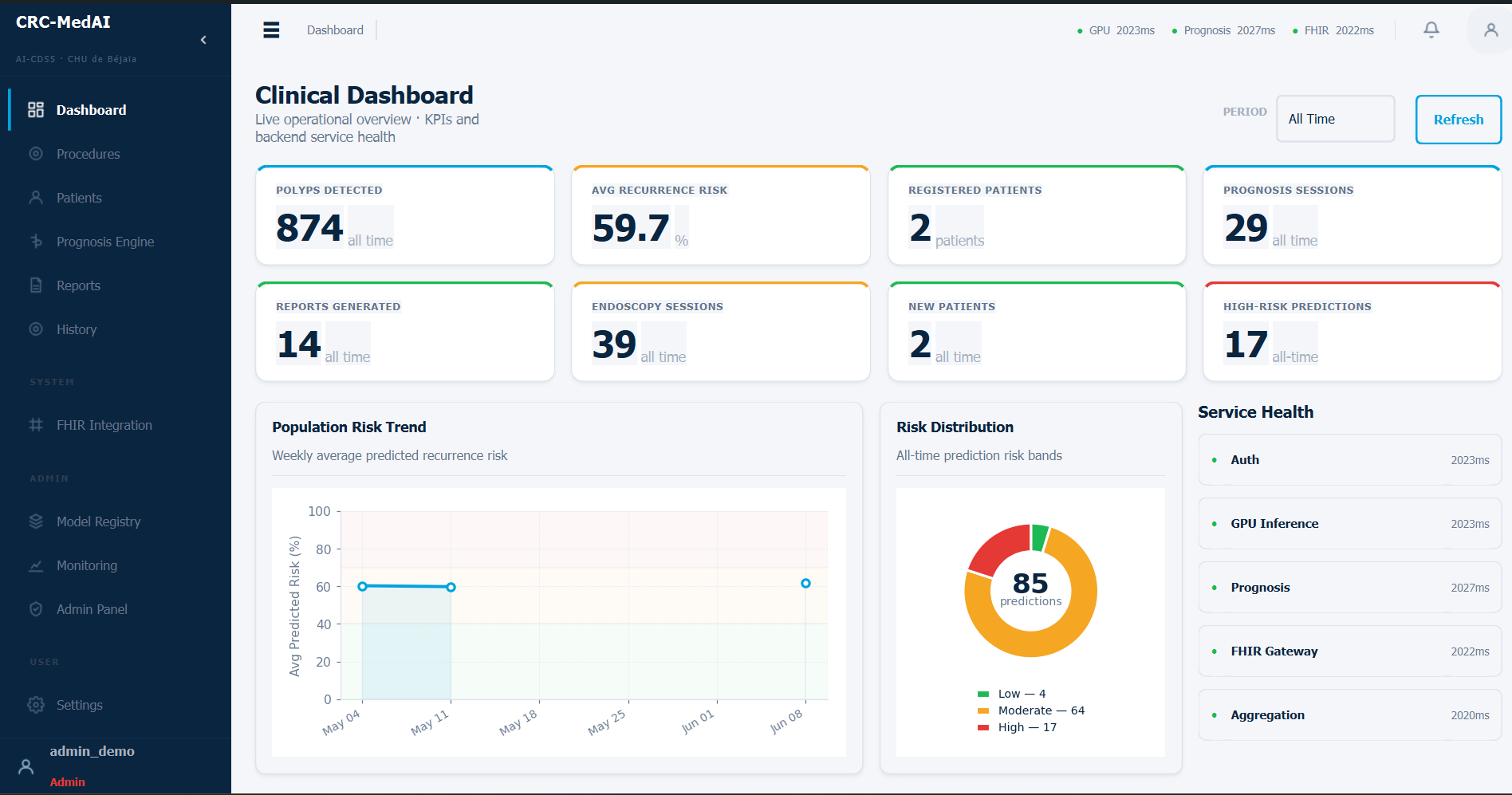
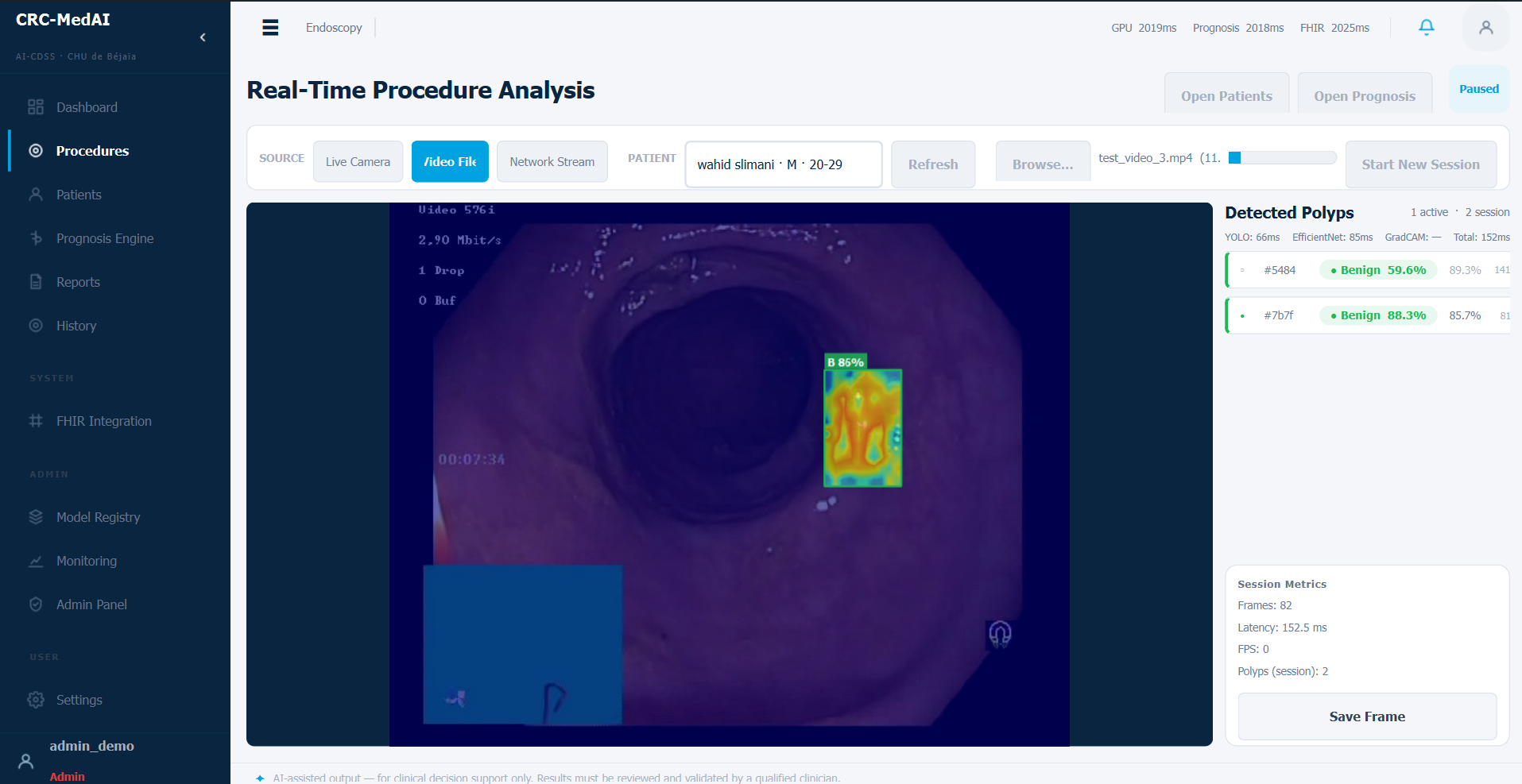
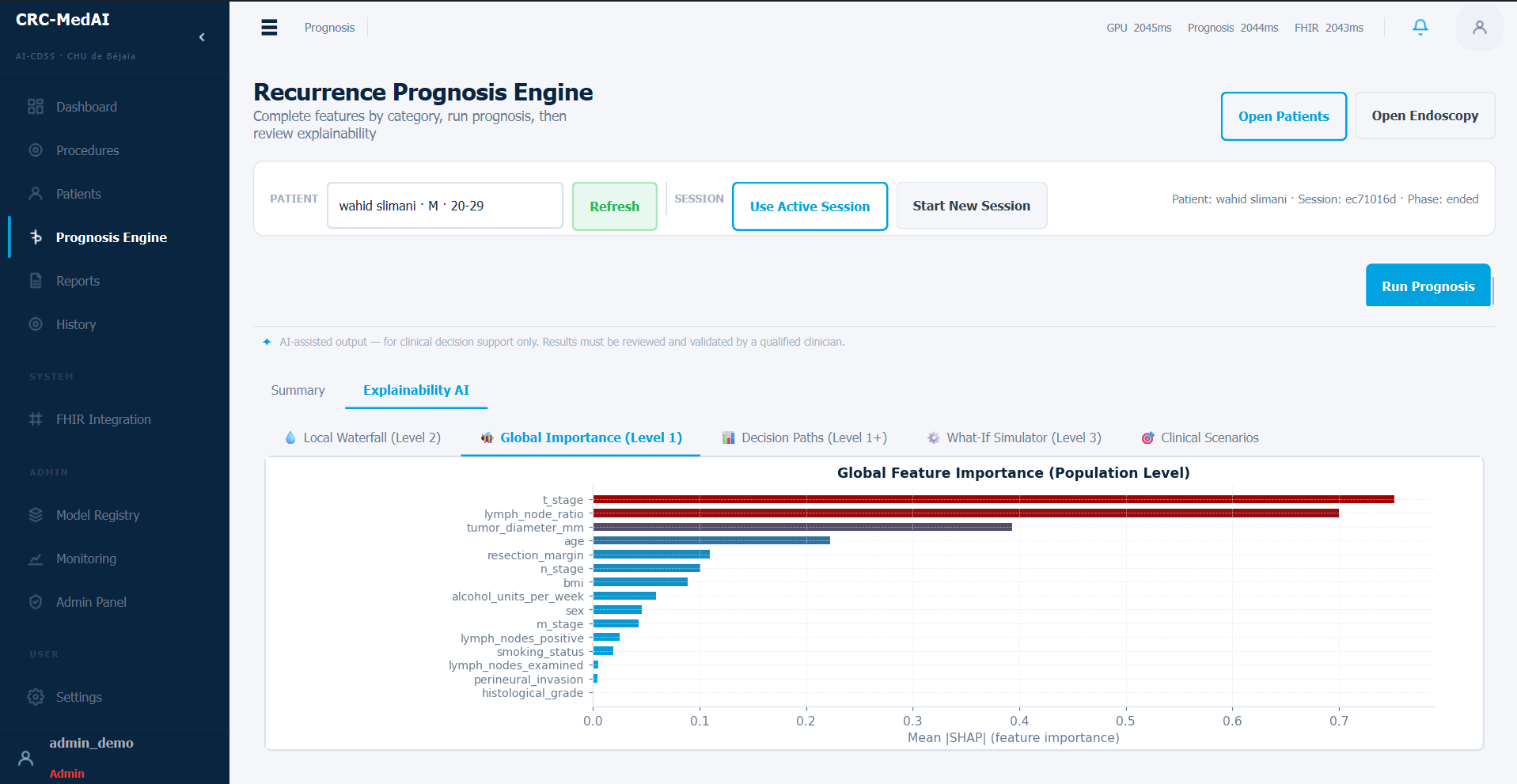
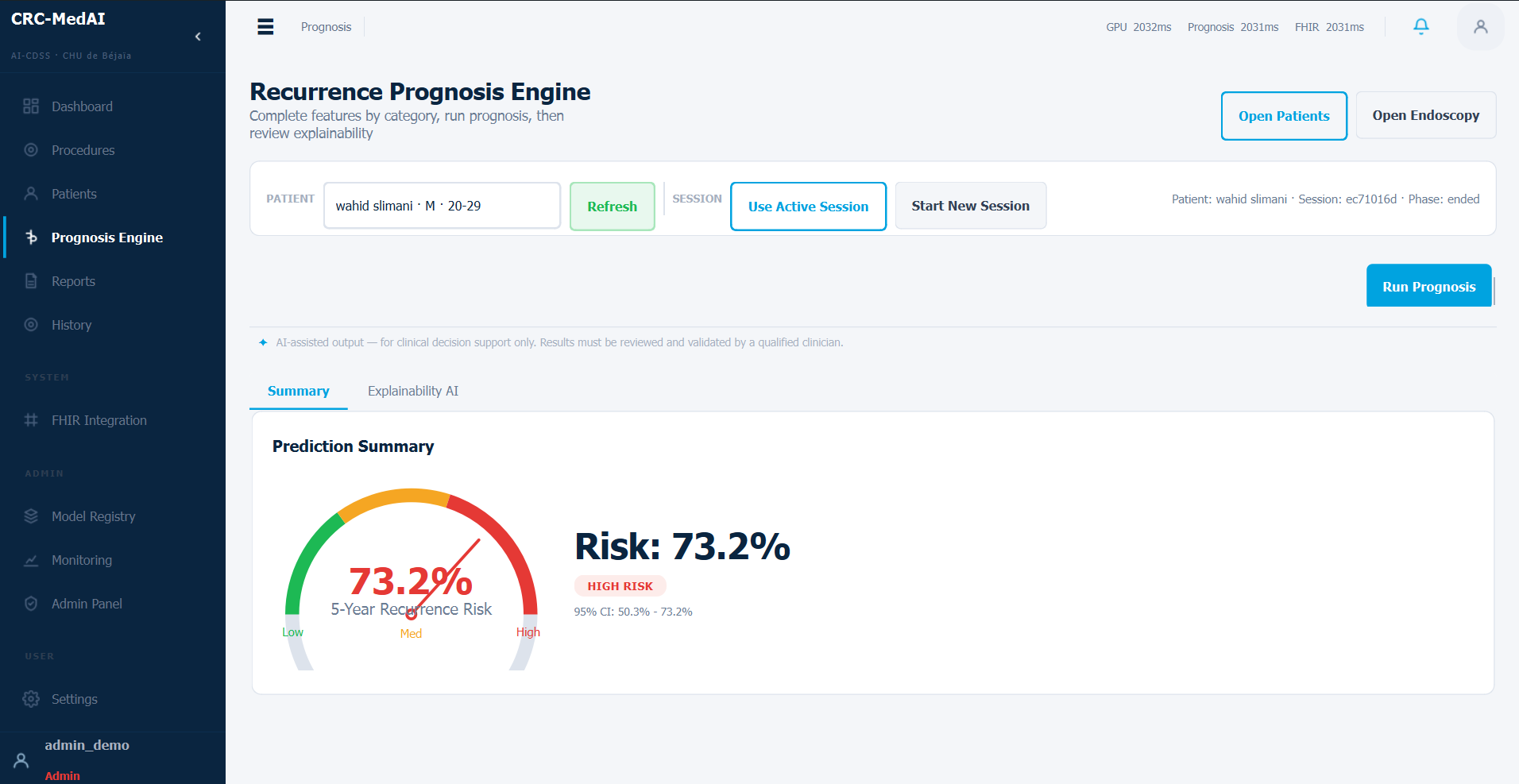
I built a dual-branch system that handles detection and prognosis, then wrapped it in the engineering a hospital actually needs. The detection branch runs real-time procedure analysis with Grad-CAM heatmaps over the endoscopy stream, so a flagged polyp comes with the reason it was flagged. The prognosis branch predicts recurrence risk and exposes it through SHAP feature importance, decision paths and a what-if simulator, so a clinician can interrogate the score rather than take it on faith. End-to-end ML pipelines cover training, evaluation, inference and deployment under MLOps discipline, and FHIR-based APIs let it speak the language of clinical record systems. The backend is a set of containerized microservices, so the model, the API and the record integration scale and fail independently.
The result
A working real-time pipeline: video and patient data go in, and structured, explainable predictions come back through standard healthcare APIs. Inference latency, throughput and per-service health are tracked live in Grafana, so the model is observable in production instead of being a black box. Supervised at ESTIN with CHU de Béjaïa, and targeted at IEEE CBMS 2026.
Highlights
- Dual-branch system: real-time detection plus recurrence prognosis
- Explainability built in: Grad-CAM heatmaps for detection, SHAP and a what-if simulator for prognosis
- FHIR interoperability so it plugs into clinical record systems
- End-to-end MLOps pipeline, from training to deployment
- Live inference monitoring (latency, throughput, health) in Prometheus and Grafana
- Containerized microservice backend
Stack
 PyTorch
- Computer Vision
- MLOps
- FHIR
 FastAPI
 Docker
- Microservices
 Prometheus
 Grafana
Inside the build
RSM Suite